Hands-on training, applied research and consultancy in robotic welding, wire arc additive manufacturing and non-destructive testing, in association with the Indian Welding Society.
The Centre for Robotic Welding & NDT, functioning under the Department of Mechanical Engineering at KPR Institute of Engineering and Technology (KPRIET), is a specialised facility for advanced welding, metal additive manufacturing and Non-Destructive Testing (NDT). It was set up to bridge the gap between classroom learning and the automated fabrication practices followed in modern industry.
Equipped with a robotic welding system, the Centre supports hands-on training, applied research and industrial problem-solving in the joining and fabrication of stainless steels, nickel-based superalloys and dissimilar-metal combinations. Research focuses on pulsed GMAW, WAAM, post-process cryogenic treatment, and the evaluation of microstructure, residual stress and mechanical behaviour.
Findings have appeared in reputed international journals and in book chapters published by Wiley and CRC Press. The Centre also offers skill development courses, short-term training, internships and consultancy in association with the Indian Welding Society (IWS).
To be a nationally recognised Centre of Excellence in robotic welding, metal additive manufacturing and non-destructive testing, nurturing skilled professionals and delivering industry-relevant research.
To provide hands-on training and advanced facilities in robotic welding and non-destructive testing, to carry out high-quality research on advanced joining and metal additive manufacturing of engineering alloys, and to support industry and academia through consultancy and skill development programmes.
Programmable robotic arc welding for consistent, high-quality joints.
Layer-by-layer metallic components using arc-based wire deposition, including CMT cycle-step and DP-GMAW variants.
Single-pulse and double-pulse Gas Metal Arc Welding of advanced alloys.
Joining of Inconel, Hastelloy, Monel, Haynes and austenitic stainless steels.
Effect of post-weld and post-deposition deep cryogenic treatment on structure and properties.
Microstructure, residual stress, mechanical behaviour and hot-corrosion performance.
Inspection and evaluation of weld quality without damaging the component.
Simulation and intelligent approaches for welding process prediction.
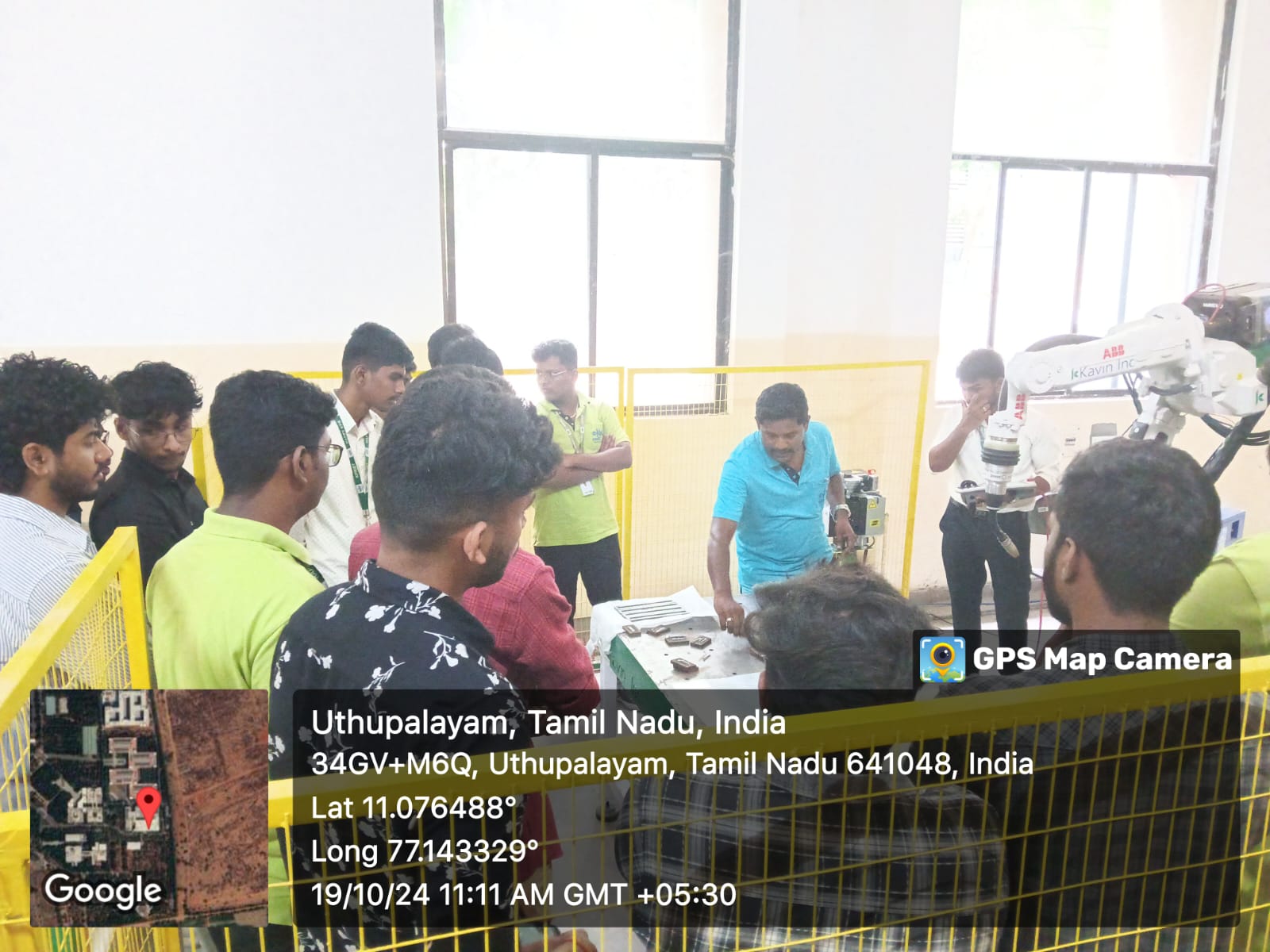
ABB IRB 1520 / Kempi Power, MIG source / 6-Axis Robotic Welding System / WAAM
₹34,22,000Numbers show participants. Alongside these, the Centre ran hands-on sessions and consultancy (22.02.2025 to 14.08.2026) for 15 external users from 9 colleges and 1 industry.
Eight SCI Q1 papers (2024 to 2026) and four book chapters with John Wiley & Sons and CRC Press. Impact factor shown on the left.
Ajithkumar Sitharaj, Natesh M, Mageshkumar K, Vignesh M, Arulmurugan B, Sathishkumar M. Journal of Materials Research and Technology, 42, 4324–4340 (SCI, Q1)
Arulmurugan B, Sitharaj A, Vivek R et al. Discover Materials (SCI, Q1)
Ajithkumar S, Arulmurugan B, Manikandan M, Sathishkumar M. Scientific Reports (SCI, Q1)
Ajithkumar S, Arulmurugan B. Journal of Materials Science (SCI, Q1)
Ajithkumar S, Arulmurugan B. Metals and Materials International (SCI, Q1)
Robotic welding and NDT training, skill development and consultancy.
01.04.2022 to 31.03.2027
Robotic welding, skill development and consultancy.
October 2026
NDT training.
October 2026
Centre email: hod_mech@kpriet.ac.in
Coordinator: arulmurugan@kpriet.ac.in
Phone: 0422-2635600
KPRIET – An AI Integrated Campus
Preparing future-ready engineers with AI-integrated teaching and learning. KPRIET integrates Artificial Intelligence across teaching, learning, research and innovation to create a smarter, future-ready campus experience for students and faculty.